
Supporting a freelance journalist and writer
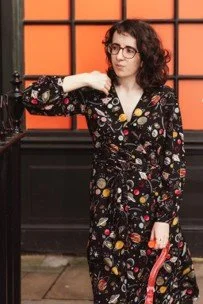
A photo of Lydia Wilkins. Lydia is a white woman with loose, curly, shoulder-length brown hair and glasses. She’s wearing a black long-sleeved dress covered in a colourful planet and space pattern. She’s standing outside in front of an orange and black window, with one arm resting on a railing and the other by her side, holding a bright red walking stick. She is looking off to the side.
About Lydia
Lydia is a freelance journalist and editor whose work focuses on disability and social inequality. As a disabled person herself, she knows first-hand how difficult navigating the working world can be when workplaces and recruitment processes are not designed with disabled people in mind.
Lydia received her autism diagnosis in 2015: “It was very much a time and a place where I was told continually that I would never achieve anything.” This ultimately led to her deciding not to pursue a university degree, later completing a journalism diploma instead.
On completing her diploma, breaking into journalism came with significant barriers. Lydia experienced discrimination as a disabled person and found that employers often lacked an understanding of disability, reasonable adjustments, and the Equality Act 2010.
Recruitment would be particularly difficult. Rather than being able to focus solely on demonstrating her skills and experience, Lydia frequently had to explain what reasonable adjustments were and what employers needed to do to make their processes accessible. These barriers led to Lydia becoming self-employed, as traditional routes into employment were often inaccessible to her.
Journey to SIC
During the pandemic, Lydia’s circumstances changed further after she developed Long COVID, adding to several existing disabilities and affecting areas of her day-to-day life, including her mobility and memory.
Lydia came across SIC on social media while looking for support with employment and career development. This began an ongoing relationship with the organisation. Lydia initially received support with her CV, career coaching and mentorship from Alice and Rachael, and has since spoken at SIC events and co-hosted an event alongside Alice on careers in writing.
SIC’s support
For Lydia, the personalised nature of SIC’s support was particularly important. Alice, SIC’s CEO and co-founder, helped Lydia revamp her CV. “The CV got me a number of different opportunities. It got me to London Fashion Week. It got me into places like Glamour Magazine.” For Lydia, Glamour was a place she’d always wanted to be published, having written to the magazine as a kid and received a typed reply from the editor that she still has.
“Alice also gave me a lot of different pieces of advice in terms of kind of like presentation, how to translate yourself. I feel like the book contract that I signed last year, I'd not have got that if she had not been in contact with me.” The support extended beyond practical changes to her CV. Lydia received ongoing advice and coaching as she navigated the challenges of developing a freelance career.
SIC’s support became especially valuable when the agency that had previously represented Lydia closed. During this period, conversations and encouragement from Alice helped her continue searching for representation, eventually leading to her current agent: “If Alice had not been talking to me at the time, I would not have found my current agent.”
SIC’s impact
Lydia’s relationship with SIC developed beyond receiving individual career support and work experience. She has since collaborated with SIC on talks, panels and careers-focused activities, including a Careers in Writing event.
The event developed after Lydia and fellow journalist Amy Arthur approached Alice with an idea around self-employment. SIC worked with them to develop the event and was able to secure some funding. Lydia and Amy led the event's development, from planning discussions to contributing ideas and suggesting speakers.
Reflecting on her overall experience with SIC, Lydia described it as “incredibly positive” and said she has recommended the organisation to others. What stood out was SIC’s non-patronising approach and the “autonomy and agency” she was given in navigating her career.
Lydia has also been able to develop a strong friendship with Alice: “I feel like we cause chaos whenever we get together”, a sentiment that Alice definitely echoes.
Why SIC's work matters
Lydia’s experience shows how SIC’s support can develop beyond a single intervention. What began with career support and work experience developed further, as Lydia was later able to bring her own professional and lived experience into SIC’s work.
Her journey also highlights the importance of addressing the disability employment gap through more than simply helping people find work; by providing personalised career support, creating accessible and inclusive opportunities and involving disabled and neurodivergent people in shaping its work, SIC can help address the barriers that prevent many from entering, progressing and remaining in their chosen careers.